
As an educator in an online distance, flexible learning (ODFL) context, the greatest motivation for me is seeing my learners succeed in their courses and qualifications, all the while learning flexibly at a distance and managing studies along with life and work commitments. Learning in this context becomes anytime, anywhere study and can be engaged in from the comfort of one’s home or elsewhere at a time that best suits one’s needs and lifestyle.
While the education journey of fully online learners might seem easy, it is not, as work commitments, life priorities, and challenges along the way often take time away from studies. Nevertheless, full online studies are a real boon as they help to gain access to education for people who may struggle to take time off from their responsibilities to study. For some, it is an avenue to find meaningful employment and, for others, a chance to upskill and move up their careers. When my fully online learners provide positive feedback on their study experiences and the value received for their careers, it is very uplifting for me.
Today, we see fully online courses with rich interactive content delivered via digital learning platforms. My experience is of high-quality content/courses with in-built activities/tasks, discussion forums, links to resources, or video content where learners have the opportunity to analyse, link content, reflect and exchange views while also communicating within the online course. In fully online courses with asynchronous communication, however, forming a community of learning which includes real-time facilitation and feedback is a challenge due to constraints placed on learning through and with peers in real-time.
Research evidence shows that online learners face feelings of isolation and a feeling of ‘lack of community’. This topic of engagement among online learners has been a widely studied topic of research inquiry. For example, when I typed in the keywords ‘online learning’ and ‘engagement’, the results thrown up by a basic search engine such as Google Scholar are 4,310,000. This goes to show the popularity of this topic and how it has engaged the minds of researchers over the years.
Creating engagement in a fully online learning environment, would often involve three levels of interactions -interaction with content and assessments, interaction with tutor and interaction with each other (Moore, 2016). The third type of interaction -between learners and other learners often differentiates face to face from online learning (Moore & Kearsley, 2012). It might be argued that online learners disengage from courses not because of content issues but because of the absence of interactions and community feelings that are often key to classroom teaching.
So, a key question is how do we ensure our fully online courses not only facilitate interaction with content and assessments but also with course facilitators and peers? This is no easy task given that the very features of fully online learning – self-directed, agency in learning, flexibility and self-paced often make the third kind of interaction, learner-learner, difficult if not impossible.
I believe an integrated approach is needed, one that addresses questions such as- how are learning tasks designed? What is the role of the tutor? What is the role of quality feedback in promoting learning? What are the opportunities to interact and engage with other learners? and What level of pastoral support and care is available? Answers to these questions might help us grow toward forming a community among fully online learners. It is important to note though, that these still need to work asynchronously, as forcing synchronous learning might negate the very benefits of distance learning.
A road map for community of learning in distance learning contexts
A framework on how to create a more connected and supportive online learning environment is discussed below (Please refer Figure 1)
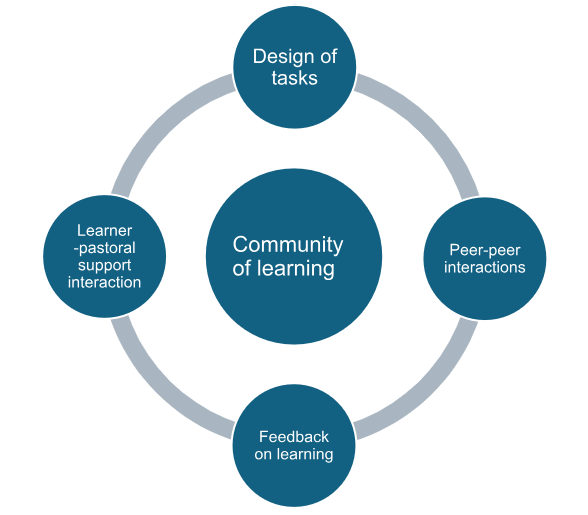
Figure 1: A framework for supporting community of learning in distance learning contexts
It is crucial to design a mix of asynchronous tasks that involve elements of peer learning and collaborations. In one of my courses with learning outcomes related to critical thinking, I saw first-hand the value of incorporating peer involvement in assessment tasks. In this assessment, the learners first completed a critical reflection in response to a chosen reading; second, they marked and provided feedback on another learner’s critical reflection on another reading; and third, they reflected on this exercise of marking a fellow student’s work. I found learners showed an appreciation for this task as marking another student’s critical reflection enabled them to learn at a deeper level.
Peer-peer interactions, formal and informal, can be arranged through a range of consciously designed approaches with the aim of supporting a community of learning and sustaining the need for achievement and affiliation. Technological tools such as shared Google Docs, online whiteboards, etc, can be excellent tools to enable collaborative work and deep learning. Other suggested strategies for building community are in-built discussion forums, ice breaker activities, regular virtual online meets, networking sessions, online course-related chat sessions or social catch-up, to name a few. Publicly celebrating student success and efforts is also key to maintaining motivation and goal-directedness and helping lift spirits.
Receiving feedback on learning is another way to promote a sense of community. Besides feedback on summative assessment, feedback on course formative activities is also key to scaffold learning so that learners feel confident and supported with their learning. Additionally, implementing a peer feedback and review system where other learners provide feedback on assignments /projects is another way to promote enhanced learning. A system of one-on-one mentoring might also be trialled where the support of experienced learners could be harnessed to effectively mentor new learners into this learning modality.
Lastly, in a fully online learning context, an important element of support is pastoral care support at the level of tutor only or by an ecosystem comprising of study mentors, student advisors, library staff, and pastoral care groups for all/targeted groups of learners. When fully online learners know who to contact for needed support, it often provides the extra mile of support, advice and guidance and reduces frustration, which might help them continue with and succeed in their studies.
Within this framework, there are ample opportunities to use digital tools and technologies to promote a community of learning. Elements of gamification might be incorporated to make learning fun and engaging. However, any recommended strategy has to be tailored to the unique needs of fully online learners within the overarching structure of the given course/qualification, the available resources and the processes, systems and protocols compatible with the institution. Also, suggested strategies which are synchronous or have elements of synchronicity may be best offered as optional rather than as mandatory to fully support learner flexibility and choice. Setting of clear expectations for engagement and participation is needed along with reflecting, reviewing and making necessary changes and adjustments based on assessing what does and does not work.
Integrated concerted efforts are needed to bridge the ‘distance in distance learning’. While learners may be at a distance, physical distance need not become ‘mental distance’. A learning ecosystem for fully online learners that is targeted and individualised to meet learner needs and facilitates high-quality learning and opportunities for interaction is needed. Building a community of learning involves learners, peers, tutors, and learning support systems interacting with each other supported with digital resources, tools, and technologies in a fully online learning context.
References
Moore, R. L. (2016). Interacting at a distance: Creating engagement in online learning environments. In K.-B. Lydia, B. Joseph, N. Esther, & A. Cynthia (Eds.), Handbook of Research on Strategic Management of Interaction, Presence, and Participation in Online Courses (pp. 401-425). Hershey, PA, USA: IGI Global.
Moore, M. and Kearsley, G. (2012) Distance Education: A Systems View of Online Learning. 3rd Edition, Wadsworth, Belmont.
Author
Dr. Shilpa Jain is a Principal Academic, Learning Delivery at the Open Polytechnic of New Zealand. With over 20 years of academic experience across diverse cultural settings, she has taught Business Management and Human Resource Management courses, previously in face-to-face teaching and now in ODFL modality. She has a Doctorate and a Master’s in Business Management, as well as a New Zealand Certificate in Adult and Tertiary Teaching and a Diploma in French Language from France. Her research focuses on workplace stress, job burnout, flexible work arrangements, employee engagement, workplace teams, and business sustainability. Dr. Jain has several peer-reviewed international publications and recently received the Emerald Literati Outstanding Paper Award for her co-authored article in Benchmarking: An International Journal. In her free time, she enjoys spending time with her family and exploring the beauty of Aotearoa.