 Home | Reports | Profiles | Issue Papers | About the Project | Project Sponsors | Te Reo Maori Home | Reports | Profiles | Issue Papers | About the Project | Project Sponsors | Te Reo Maori |
Amana Christian Schoolhttps://amana.school.nz/ |
|
| # of unique students – Up to 60 Type of provider – School, private Primary distance modality – Independent Study |
Background
Amana Christian School is a co-educational, private composite school based in Mosgiel. The Education and Training Act, 2020 defines a composite school as “a school that offers education to students in any of years 1 to 8 and in any of years 9 to 13” (Government of New Zealand, 2024a, p. 38). Amana Christian School offers students both an in person or face-to-face option and a distance learning option. The school indicates that their distance learning curriculum (i.e., Accelerated Christian Education [ACE]) has been used since 2015.
Governance
According to the Education and Training Act 2020, a private school is defined as a school registered under section 214, which reads:
214 Registration of private schools
(1) This section applies if the managers of an existing school or proposed school wish the school to be registered as a private school under this section.
(2) The managers must apply to the Secretary, on a form provided by the Secretary for the purpose, for its provisional registration as a primary, secondary, or special private school, or as a school of 2 or all of those descriptions.
(3) The provisional and full registration of private schools, and the operation of private schools, must be done in accordance with Schedule 7. (p. 164)
Schedule 7 of the act provides approximately 10 pages of legislative regulation around the following areas.
- Provisional and full registration of private schools
- Criteria for registration as private school
- Suitable premises
- Additional and substituted premises to be approved
- Tuition standards
- Managers to be fit and proper persons
- Manager must have regard to statement of national education and learning priorities
- Managers must advise Secretary of school ceasing operation
- Review of private schools
- Secretary’s actions in relation to private schools
- Duration of suspension
- Process for cancellation of registration
- Grants for private schools
- Record-keeping in relation to grants to private schools
- Providing accounts to Secretary
- Suspensions and expulsions from private schools
Resourcing
As a private school, Amana Christian School is primarily resourced through individual tuition paid by the students and their families. According to the school’s website, the current fee structure is as follows.
| # Children | Fee Per Term | Fee Per Year | Cost Per Child Per Year |
|---|---|---|---|
| 1 Child | $790 | $3,160 | $3,160 |
| 2 Children | $1,355 | $5,420 | $2,710 |
| 3 Children | $1,750 | $7,000 | $2,333 |
| 4 Children | $1,985 | $7,940* | $1,985 |
ACE curriculum costs (year 7 & 8) are $200 per year
ACE Curriculum costs (year 9 – 13) are $500 per year
* $7,940 is the most any family will have to pay per year for fees (this includes ACE curriculum costs)
There was no difference in the tuition for enrolment in their brick-and-mortar school or their distance learning programming.
Finally, the government does provide grants to private schools through the private school subsidy funding pool (Ministry of Education, 2024a), which is distributed at a set rate per student. According to Circular 2022/08 – Private School Subsidy Funding 2023 the rates for 2023 were (Ministry of Education, 2022):
| Year Level | 2023 Funding Rate GST Exclusive | 2023 Funding Rate GST Inclusive |
| Year 1-6 | $880.54 | $1,012.62 |
| Year 7-8 | $964.23 | $1,108.87 |
| Year 9-10 | $1,234.01 | $1,419.11 |
| Year 11-15 | $1,874.16 | $2,155.28 |
Based on the data from Official Information Act Request 1321408, Amana Christian School received funds in 2023 from this subsidy (Ministry of Education, 2024b). Unfortunately, the response to the request only lists the schools that received funding, and not the amount of funding or any details on how it was used.
Programming
The programming offered by Amana Christian School is based on the ACE curriculum, which was developed by an American company and is based on a literal interpretation of the Bible with a conservative, evangelical perspective. It should be noted that there has been a long history of criticism of the ACE curriculum (see Berliner, 1997; Fleming & Hunt, 1987; Laats, 2010). The actual ACE curriculum includes Packets of Accelerated Christian Education (PACEs), with approximately 12 packets for each core subject. The ACE website describes the packets as “self-instructional,” which allow “students to learn with minimal supervision.” The school’s website indicates that “at the beginning of each PACE is an overview of what the child will be learning, a Scripture to memorise, a character trait to strive toward, and a “heads up” on what supplies the student will need.” Amana supplements the ACE curriculum with both a New Zealand-based Interact Curriculum (which is described as “biblically based resources”1), as well as the national curriculum.
The school’s own website also describes the instructional model as:
- students have a daily plan and work at their own pace through the assigned work;
- work is primarily carried out using workbooks;
- new works books are sent out at regular intervals, in time to coincide with completion of the current workbook;
- both the teacher and their support person review work and provide feedback to the student. This includes individual, small group, and class;
- the schoolwork covers a range of teaching methods, including: directed learning, lectures/presentations, self-managed learning, assignments, projects, activities;
- the programme is structured around regular marking, follow-up teaching, revision and testing; and
- increasingly students take ownership of their own learning by setting daily, weekly and term and yearly goals.
The school’s website does provide a sample timetable.
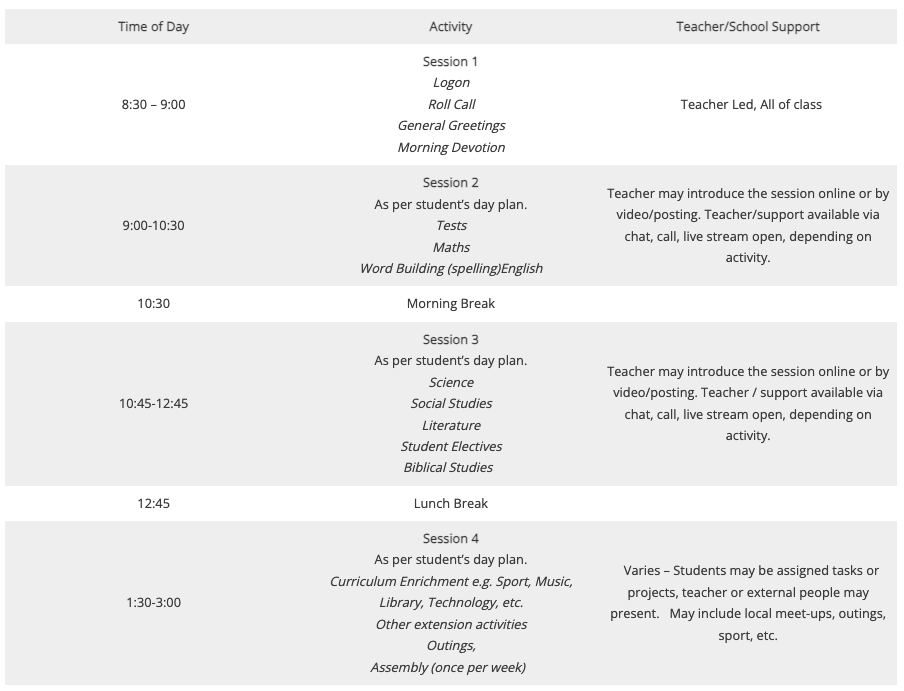
Finally, the school’s own promotional material suggests that “distance learning will typically have 1 x Teacher (0.75 FTE) and 1 x Teacher Support (0.25 FTE) per 20 to 25 students.” This model is based upon a strong parental presence, where the school recommends that “parental involvement is essential and includes:
- establishing a work area,
- age appropriate supervision – helping the child get set for the day, managing the work schedule, etc.
- supporting the teaching routine,
- providing feedback to the school and teachers, and
- engaging with your local community is strongly encouraged.
Activity
According to the Education Counts website, the school enrolment is described as so.
| Level | Total |
|---|---|
| Year 01 | 0 |
| Year 02 | 4 |
| Year 03 | 4 |
| Year 04 | 5 |
| Year 05 | 8 |
| Year 06 | 5 |
| Year 07 | 9 |
| Year 08 | 8 |
| Year 09 | 5 |
| Year 10 | 4 |
| Year 11 | 6 |
| Year 12 | 0 |
| Year 13+ | 2 |
| Total | 60 |
There were 13 students of Māori descent enrolled.
Amana Christian School indicated that the number of students on site was less than 20 students.
References
Berliner, D. (1997). Educational psychology meets the Christian right: Differing views of children, schooling, teaching, and learning. Teachers College Record, 98(3), 381-416.
Fleming, D. B., & Hunt, T. C. (1987). The world as seen by students in Accelerated Christian Education schools. Phi Delta Kappan, 68(7), 518-523.
Government of New Zealand. (2024a). Education and training act 2020. https://www.legislation.govt.nz/act/public/2020/0038/latest/LMS170676.html
Laats, A. (2010). Forging a fundamentalist “one best system”: Struggles over curriculum and educational philosophy for Christian day schools, 1970-1989. History of Education Quarterly, 49(1), 55-83.
Ministry of Education (2022). Circular 2022/08 – Private school subsidy funding 2023. Government of New Zealand. https://www.education.govt.nz/our-work/publications/education-circulars/latest-circulars/circular-2022-2/
Ministry of Education (2024a). Resourcing information for private schools. Government of New Zealand. https://www.education.govt.nz/school/funding-and-financials/resourcing/private-schools-resourcing-information/
Ministry of Education (2024b). Responses to Official Information Act requests. Government of New Zealand. https://www.education.govt.nz/our-work/information-releases/responses-to-official-information-act-requests/
1 http://www.integratededucation.com/shop/interactcurriculum.html