
The 2024 FLANZ conference was held on the Grafton Campus at the University of Auckland’s Faculty of Medical and Health Sciences on 26-28 August. We shared, discussed, and attended workshops on Flexible Learning across the sectors. The Full Proceedings are now available and details of the 2024 Awards are detailed below..
The Asia-Pacific landscape (Australia, Fiji, Japan and New Zealand) was represented by a small group of universities, polytechnics, schools, companies, and non-for profit organisations that are truly committed to advancing the flexible online distance learning landscape. We had colleagues joining from as far as Norway and the United States to present projects and advocate for online distance learning in Aotearoa New Zealand.

Keynote speakers
Associate Professor Rhys Jones (University of Auckland)’s keynote, titled “Radical flexibility: centring relationality and justice in pursuit of emancipatory education” began with a whakatauki:

Kia whakatomuri te haere whakamua (I walk backwards into the future, with my eyes fixed on the past).
This whakatauki which suggests “a looking back for what comes after” was a key idea of Rhys’s talk illustrating how influences of colonisation have led us away from original instructions and different world views have emerged.
Associate Prof. Rhys Jones’s keynote drew on his prolific career insights specialising in public health at University of Auckland to throw light on issues of equity, indigenous health Māori haoura and the relationships between environment and human well-being.
Orienting the audience to the wicked problems that the world is grappling with – climate change, biodiversity, human rights, humanitarian crises – he advocated for higher education to navigate and adapt to unpredictable, shifting circumstances and a mechanism to imagine and create better futures.
The concept of radical flexibility involves asking existential questions about our place on this earth, the purpose of learning and the kind of future we want. Among his keen insights was the 6-point plan for advancing planetary health-restoring connections with nature, recognising rights of nature, critiquing dominant paradigms, returning indigenous lands, protecting and revitalising indigenous languages and supporting communal, intergenerational living.

Aligning with the future we want, he advocated for a kind of education which is not only about gaining knowledge, but also embedded in communities, and is relational and based on mutual responsibilities in a broad web of relationships. In designing an approach to education, he strongly believes there is a need to confront colonialism in education which give rises to stereotypes and biases in society, advocate Kaupapa Māori pedagogies with focus on indigenous rights, social justice, critical consciousness, relational thinking and focus on the ‘causes’ including the systemic biases that are embedded in society.
The session was very enriching and thought-provoking in which audiences experienced an interweaving of key questions and ideas around colonisation, colonialism, racism, climate change, indigenous health, relationality, responsibilities, critical consciousness, and how they form the context from which to create the future we want through education.
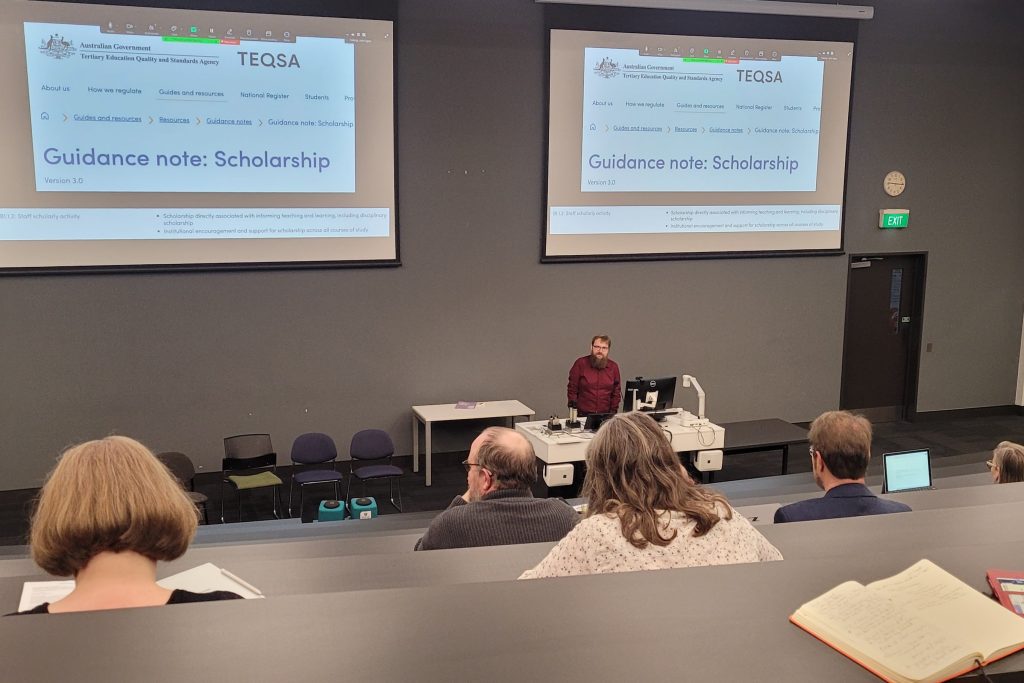
Associate Professor Michael Cowling (Central Queensland University) keynote was titled “Pedagogy Before Technology: Exploring the Complex Relationship between Technology Enhanced Learning [TEL] & Scholarly Practice”.

Associate Professor Michael Cowling discussed the idea of ‘scholarship’ in classrooms and in the world. He presented it as a three-legged stool with the seat of the stool being the central concept of ‘scholarship’ and the three legs of the stool being ‘Teaching’, ‘Research’, and ‘Service’, which faculty are trying to manage. His talk was interspersed with vignettes about recent articles, online resources, and webinars on the theme of digital education, teaching and learning, and the role of technology.
In speaking to ‘pedagogy before technology’ Cowling observed that the top 10 global companies were tech companies. Suggesting that a position of no tech in classrooms is myopic. However, he argued for a model in which pedagogy comes before technology – a model of tech enhanced learning (TEL).
In practice this involves asking three key questions
- What is the problem?
- How can I solve the problem?
- How can technology help?
Cowling is clear that there needs to be sound pedagogical reasons for using technology. This approach needs to be framed within theoretical and methodological rigour and include people for its success. Overall, it was an insightful session that combined real-world expertise with academic richness in expounding the value of teaching and learning which is enriched and enhanced by using technology.
Papers An Introduction to Topics and Institutions
Presenting in-person or online, the delegates’ papers were on a broad range of topics in the areas of teacher professional development in tertiary and school education, course design and development, secure assessment and artificial intelligence. Other papers reported on the use of contemporary technologies in learning settings, the state of distance learning, marking at scale, and understanding student emotions.
Topics on teacher professional development in tertiary and school education:
- Culturally responsive dispositions and practices (Massey University & University of Waikato)
- Creating a scalable and sustainable professional development ecosystem (Massey University)
- Evolving online practices in virtual environments (Kōtui Ako Virtual Learning Network)
- The learning design studio workshops (University of Melbourne)
Topics on course design or enhancement:
- Improving outcomes for students particularly identifying as Māori, Pasifika, or disabled (Lincoln University)
- Equitable access through offering dual mode of delivery (University of Auckland)
- Exploring a micro-credentials pathway for working health professionals (University of Auckland)
Topics on course development:
- Building the resilience of technical and vocational education and training in the Pacific (Commonwealth of Learning & University of the South Pacific)
- Reporting on a study exploring levels of engagement and sense of community in the blended delivery of a re-designed nursing programme (University of Canterbury)
- Incorporating a Pacific (particularly Tongan) approach to relational asynchronous teaching in a business programme (University of Auckland)
Topics on secure assessment and artificial intelligence:
- Formative assessment in distance and flexible learning (Open Polytechnic),
- Exploring students perspectives of automated interventions with integrated human support (Open Polytechnic & Universität Oldenburg)
- Constructive alignment (Open Polytechnic)
- Challenges in implementing e-proctoring exams at a regional university in the South Pacific during COVID-19 (University of the South Pacific)
- The use of Interactive Oral Assessment to support assessment integrity (Open Polytechnic)
Topics on the use of contemporary technologies in learning settings:
- Video integration strategies to foster social presence and immersive experiences in online learning (Lincoln University)
- Adapting Lego Serious Play into adult learning (AcademyEX)
- How FRAME VR is used to deliver online English as a foreign language lessons to Japanese university students learning in remote locations (Otemon Gakuin University & Okayama University)
Topics on the state of distance learning, marking at scale, and understanding student emotions:
- Findings on how the “Pulse” tool could help understand learners’ emotional experiences in online learning (Open Polytechnic)
- A report on “An exploration of the state of distance learning in New Zealand’s school sector” (Touro University California & FutureMakers NZ)
- How “Assessment Teams” support consistency in marking in large scale online distance flexible delivery (Open Polytechnic)
2024 Best Paper Awards
Best full paper “Dual mode of delivery to improve equitable access to medication management course” by Dr Gigi Lim, University of Auckland
This paper reports on a dual mode of delivery model (online and on campus) for a course on medication management offered by Faculty of Medical and Health Sciences within the University of Auckland, and its effects on students’ experiences, results and learning outcome. It was found that students positively evaluated the online course and there were no differences in student outcomes. On-line learning provided an opportunity for students to access and complete a core paper to improve clinical practice.
Best practice paper “Immersive experiences for online learning: Integrating 360° media with embedded videos, and text resources” by Dr Terry Meechang

This paper reports on Lincoln university’s experience with using 360 degree media and spatially located resources to offer authentic real-world learning experiences for learners. Examples from recent courses and insights from students were shared with positive student feedback on immersive courses noted. This approach serves as a potential model for other institutions aiming to enhance their online education offerings through immersive technologies.
People’s choice “Is this the beginning of a beautiful friendship? Constructive alignment and artificial intelligence” by Dr Jennifer Kirby
This paper explores connections between constructive alignment and use of Artificial Intelligence in the ODFL context of Open Polytechnic of New Zealand. An internally developed Course-o-Matic, a secure Application Programming Interface (API) that interacts with the OpenAI models was used to assess the alignment between intended learning outcomes and learning activities. The findings show that AI has the potential to support alignment of courseware and provide helpful insights. However, more specific prompting strategies may be required to tailor responses to ODFL context.
Highlights of the School Sector Papers
The New Zealand school sector was represented in the programme by a full paper on the state of distance education, one practice paper on teacher professional development, and one workshop on flexible authentic assessments. Next a brief summary of the papers.

The Kōtuitui Online Teachers Network, a Network of Expertise (NEX), was the focus of a practice paper presentation on Professional development for NZ school teachers in virtual environments by Lucie Lindsay, and Rachel Whalley, of Kōtui Ako VLN (Virtual Learning Network) School. They discussed the unique challenges and opportunities teaching online and emphasised the importance of targeted professional learning for online teachers to share collaborative expertise, enhance teaching practices, and improve student outcomes in virtual learning environments. They highlighted that Kōtuitui NEX provides facilitation, support, and leadership for online teaching and learning, which continues to build effective online teacher capability and grow the flexibility and resilience of the teaching profession.
Associate Professor Michael Barbour, Touro University, and Derek Wenmoth, FutureMakers, reported on their nationwide study, the State of Distance Learning in New Zealand’s School Sector. They noted a variety of instructional models from mainly asynchronous learning using learning management systems, synchronous virtual classrooms plus independent work, to independent study. They outlined an ideal future ecosystem for schools in New Zealand with scale and sustainability that has: student agency and choice, is equitable and inclusive, cohesive and coordinated, and is innovative. They discussed the challenges in terms of a need for supporting policies and regulatory guidelines, provider accreditation, infrastructure, teacher education, resourcing and funding.
Workshops

Interactive workshops were held on using AI and digital assistants for student queries at a business school (University of Auckland); ; getting published in an academic journal (FLANZ & InfoSolutions); and the meditative practice of Conscious Chinese Calligraphy to manage stress, restore mental balance and order (Xin Huang).
In the workshop on exploring the use of generative AI in portfolio practice, Kristina Hoeppner (Catalyst IT) facilitated educators to use generative AI to support reflective practice. The need to consider where confidential learner data goes, who can see it, and how safe/secure the tool is was raised.
Flexible assessment methods for online secure authentic assessment were explored in a workshop by Alison Gonscak (Mt Hobson Academy). She shared ways Exam.net is used in NCEA and unit standard remote assessments, and resources such as video clips, reference sheets, and maths sites can be integrated into assessments. Extra support for learners, exam facilitation, monitoring methods and secure exam browsers was discussed.
The conference closed with a meeting on the future of FLANZ headed by our president Nathaniel Louwrens and the closing remarks for the conference chair John Egan.
Blog contributors: Gloria Gomez, Shilpa Jain, Lucie Lindsay
Sincere thanks to our sponsors