

As a digital learning professional with a background in educational technology and teacher education, I have been fortunate to work in various capacities across K-12, higher education, and the EdTech industry. Many people often think that educational technology professionals merely take care of digital technologies. However, educational technology encompasses much more. According to the Association for Educational Communications & Technology (AECT), educational technology is a holistic approach involving the design, development, utilisation, management, and evaluation of processes and resources for learning (Seels & Richey,1994, Richey et al., 2008, AECT, 2023). In this reflective blog, I use “digital learning” and “educational technology” interchangeably, as they both refer to the integration of technology in educational practices to enhance learning and teaching. Using both terms ensures inclusivity for those who prefer one term over the other.
Over the years, I’ve observed how advancements in digital technologies, from overhead projectors to GenAI, have reshaped educational practices. These innovations have enhanced accessibility and engagement for learners and opened up new possibilities for both learning and teaching professionals. From personalised learning to data-driven decision-making and innovative instructional design, the continuous evolution in technology provides tools to better meet learners’ diverse needs and create more effective educational experiences.
Reflecting on my journey in digital learning, I acknowledge the significant role that AECT has played in shaping the field. In 1994, AECT defined educational technology as the theory and practice of design, development, utilisation, management, and evaluation of processes and resources for learning (Seels & Richey,1994). In 2007, AECT revised the definition to highlight technology-supported teaching and learning, adding keywords such as research, ethical practice, facilitation, learning performance, and technological processes (Richey et al., 2008). Since then, the definition has undergone further amendments to reflect the evolving landscape of digital education. These changes underscore the growing importance of research, ethical practice, and the integration of advanced technologies like artificial intelligence and virtual reality in education. As a digital learning professional, understanding the study and ethical application of research and practices in planning and implementing educational technologies has been crucial for me. This understanding is essential not only for my own practice but also as a standard for instructors, with AECT serving as a snapshot and authority of the professional field to aspire to.
My journey in digital learning has enabled me to bring my foundational knowledge of educational technology and its research and application to design, develop, and teach subjects that help academics and professionals become confident in their future practices. I have proposed a digital learning competency skillset that I believe would be an ideal outcome or framework for educational technology professionals, instructional designers, and other digital learning professionals. These areas of consideration for professional development enable us to implement integrative approaches in our practices, allowing us to connect with learners using innovative pedagogy and practical digital technologies.
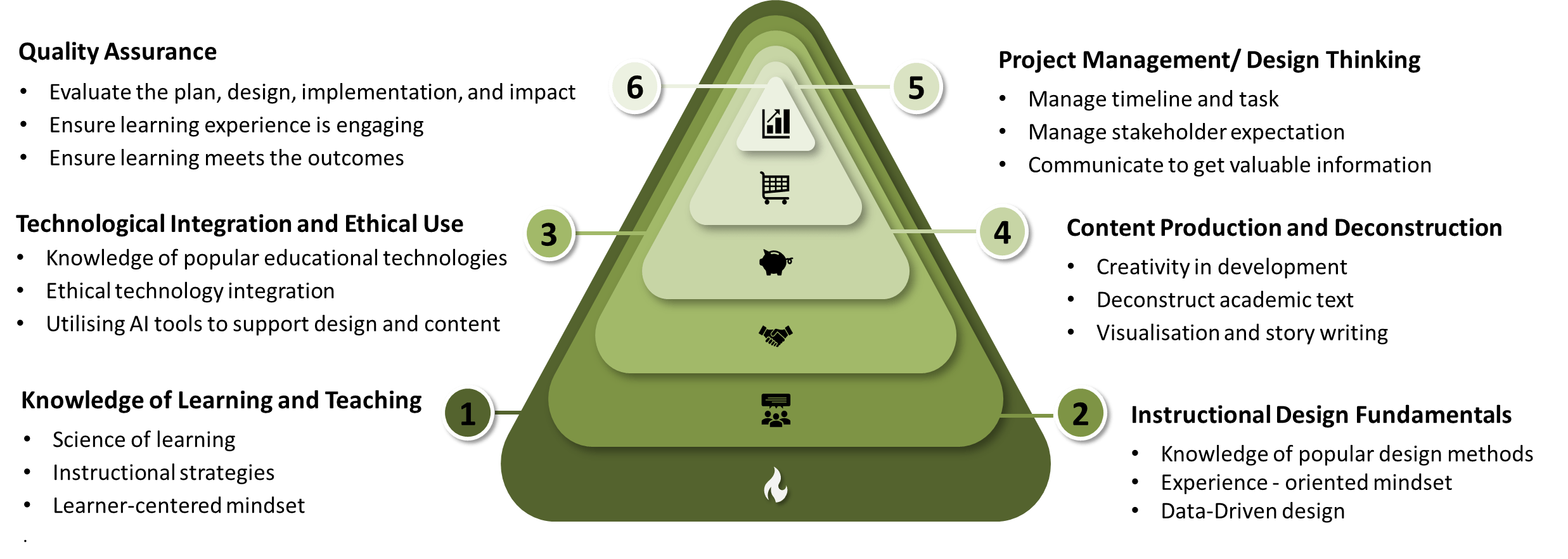
Digital learning competency skillset
Note: This diagram is updated based on the initial skillset for eLearning professionals developed by Dr Spice Wang in response to the widespread use of GenAI in education.
The digital learning competency skillset is designed to provide a comprehensive set of skills and knowledge areas that digital learning professionals need to effectively integrate technology into educational practices. The framework includes competencies such as instructional design, technological proficiency, data analytics, research and ethical practice, and leadership in digital transformation.
In the end, questions I want to address continuously include:
🎈 How can digital learning professionals and leaders work with educational stakeholders to make the digital learning transformation happen?
🎈 How can we ensure that we use digital and AI tools efficiently and ethically?
🎈 Most importantly, how can we help educators teach learners to be critical users of all innovative digital tools, including GenAI?
As we continue to explore the possibilities and innovations that technology can bring to education, it is essential to focus on evidence-based practices in understanding how learning happens and how education providers build an environment to allow educators to provide differentiated instruction and meaningful learning pathways. The new definition of educational technology issued by the AECT Definition Task Force in 2023 underscores this point (AECT, 2023):
“Educational technology is the ethical study and application of, research, and practices to advance knowledge, improve learning and performance, and empower learners through strategic design, management, implementation, and evaluation of learning experiences and environments using appropriate processes and resources”.
This holistic view shows how a digital learning or educational technology team may lead digital learning initiatives through a strategic plan, design, and management of digital and human resources. As a digital learning professional, it has been crucial for me to embrace this change and seek evidence-based practices and strategies to bring pedagogy, business, people, and processes together, ideally with scalability and sustainability.
I am fortunate to be part of this transformation and work with talented people who are experts in higher education, industry, or business leadership. Together, we can learn and embrace the affordance of digital learning through collaboration and inspiration, focusing on quality, integrity, and future possibilities. By focusing on a specific skillset that enables integrative approaches in teaching and learning practices and collaborating with educational stakeholders, we can ensure the efficient and ethical use of digital tools. This empowers educators with evidence-based strategies to provide differentiated instruction and meaningful learning pathways. Let’s continue this conversation and work together to shape a better future for education.
Acknowledgement: The original work of this blog was written and accepted for presentation at AECT’s 100th anniversary celebration in 2023. However, the author withdrew the presentation due to clashes with other commitments.
References
Association for Educational Communication & Technology. (2023). AECT definition for educational technology. Association for Educational Communication & Technology. https://www.aect.org/aect/about/aect-definition
Richey, R. C., Silber, K. H., & Ely, D. P. (2008). Reflections on the 2008 AECT Definitions of the Field. TechTrends, 52(1), 24-25.
Seels, B. B., & Richey, R. C. (1994). Instructional technology: The definition and domains of the field. Washington, DC: Association for Educational Communications and Technology.
Author: Spice Wang
Spice Wang is a formally trained teacher with a PhD in Digital Learning and Teacher Education. She is a Senior Educational Practice Specialist at the Centre for Educational Innovation and Quality at RMIT University and a Senior Fellow of the Higher Education Academy. With over 20 years of experience in K12 and higher education, Spice excels in educational research, design, and digital learning leadership. She is dedicated to enhancing student learning experiences and fostering a culture of educational excellence. Spice has extensive expertise in curriculum development, educational evaluation, and quality assurance mechanisms.