For sustainable and equitable education in a flexible online distance classroom, design of learning resources should start with understanding needs, wants, and context of each member of a classroom community. So, teaching staff and students can relate to each other in this shared educational experience.
Designing for one-size-fits-all might not bring about meaningful learning and foster connection for students who could be time-starved, reside outside of main centres, studying while working, caretaking or with disabilities. In a face-to-face classroom, teaching staff more often than not tend to adapt, transform, and innovate resources to account for student diversities. The same tendency should be possible in an online classroom. So, the relevance of these resources to learning outcomes are not devalued by students due to a perceived lack of understanding of their circumstances or conditions.
To support digital access and equity, it has been recommended to “include human-centred design [HCD] in the construction of culturally sensitive, accessible, flexible learning” (Gomez, et al., 2022, p. 27). The bridging design prototype (BDP) approach is an HCD method that transforms teachers into designers (Gomez, 2020). It could enable teaching staff to design their own novel resources for flexible online distance classrooms. For the reason that “everybody who works in education is a designer, though they may be working in different design spaces, each requiring different specificities of expertise, background knowledge, tools, and practices.” (Weiner, et al., 2020, p.781)
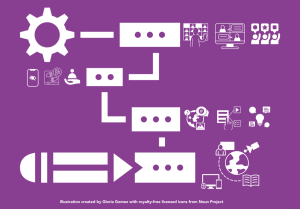
The six BDP principles (figure 1) could guide/help teachers individually or in small teams to:
• Carry out careful analysis of relevant data to inform resource design.
• Develop resources with features familiar to all members of a classroom community to enhance adoption.
• Determine when novel features should be included as part of a resource design, and plan for extra support if needed.
• Inform feature design based on a good understanding of the prior knowledge and the context realities of students and teachers alike, including those with diverse cognitive, physical, and socio-cultural capabilities.
The diagram (figure 1) provides a step-by-step guide showing how the BDP principles are organised and interact with each other during the human-centred design process of a classroom resource.

Principle “bringing a multidisciplinary thinking team approach” to learn about your online classroom community and context. Gather information (via secondary or primary sources) about your student cohort, teaching staff and yourself, as well as your programme including context and technologies. For example, in the preschool classroom, early childhood teachers apply methods (e.g., observation) to learn about each child, and connect these learnings to theoretical concepts, which in turn inform the design of learning activities and spaces.
Principle “achieving similar mental models” to stimulate empathy and solidarity. Use what you’ve learned through data gathering to become more in-tune with your online classroom community. To continue with the preschool example, the more a teacher understands needs, wants, and context of every child who is part of this educational experience, the easier it is to decide how to develop suitable resources. Are these to be comprised of familiar features only or a combination of familiar and novel features?
Principle “understanding prior knowledge and familiar interactions” to foster student engagement. You are now equipped to develop resources based on understanding that comes from identifying technologies every student or staff member are familiar with, study skills or behaviours they have already mastered, and the kinds of social interactions around learning that they prefer. When a teacher is designing a learning station in the preschool classroom, a particular child or small group of children are often in their mind. Suitable resources are selected according to age, developmental stage, diversity in capabilities so each child can carry out the activity.
Principle “making activities simpler” to promote the completion of assignments. Use the information gathered on common needs and capabilities (physical, cognitive and social) to design activities with features/skills that your students can operate/use. Ask yourself questions such as “what do I have in common with my students?” One example: do my students and I use similar technologies? Could I design a meaningful activity with a resource/technology common to all of us to save time and energy? Another example: are there any students whose writing skills need extra support? Identify who they are as early as possible so you can pre-empt who might have trouble with activities requiring strong writing skills.
Principle “broadening participation in the design process” of a resource so you can share the responsibility with your students. If someone shows signs of not being able to undertake an activity with such resource, investigate how to adapt it to their diverse capabilities or specific context. But, if this is not possible to achieve, invite students and staff to propose their own solutions.
Finally, principle “enabling participation in the design process” so students and staff can co-create their own educational experience. If the above five principles are applied, this last principle is enabled. A flexible online distance classroom designed with these six BDP principles might make students and teaching staff more relatable to each other, as well as prevent implementation of resources unsuitable to distance students across all sectors.
_____________________
References
Gomez, G., Jones, H., & Birt, J. (2022). Accessible content and digital equity. In C. Campbell, C. Porter, D. Logan-Fleming, & H. Jones (Eds.), Scanning the Ed Tech Horizon: The 2021-2022 Contextualising Horizon Report (pp. 26-29). ASCILITE. https://ascilite.org/get-involved/contextualising-horizon/
Gomez, G. (2022). The bridging design prototype approach: Strengthening the role of design as a strategic resource in small organisations. In E. Erturk & B. Otinpong (Eds.), CITRENZ 2022: Proceedings of the 13th Annual Conference of Computing and Information Technology Education and Research in New Zealand (pp. 37-47). https://citrenz.org.nz/citrenz/2022-proceedings/
Gomez, G. (2020). Bridging design prototypes & autonomous design. In R. Marques Leitão, L.-A. Noel, & L. Murphy (Eds.), Proceedings of Pivot 2020: Designing a world of many centers (pp. 166-181). Design Research Society https://doi.org/doi:10.21606/pluriversal.2020.032
Weiner, S., Warr, M., & Mishra, P. (2020). Fostering System-Level Perspective Taking when Designing for Change in Educational Systems. TechTrends, 64(5), 779-788. https://doi.org/10.1007/s11528-020-00529-w
___________________________
Author: Gloria Gomez
Dr Gloria Gomez undertakes applied design research in novel educational practice with Bridging Design Prototypes, and research through teaching and supervision in social design, inclusive design, and medical education. She is co-founder at OceanBrowser which are developers of OB3, honorary senior lecturer at the Save Sight Institute, University of Sydney, and 2023 – 2024 FLANZ executive committee member. Learn more at http://www.gloriagomez.com